Raised To Make Women Rich - Guest Post by Sandra Nomoto
Jul 27, 2026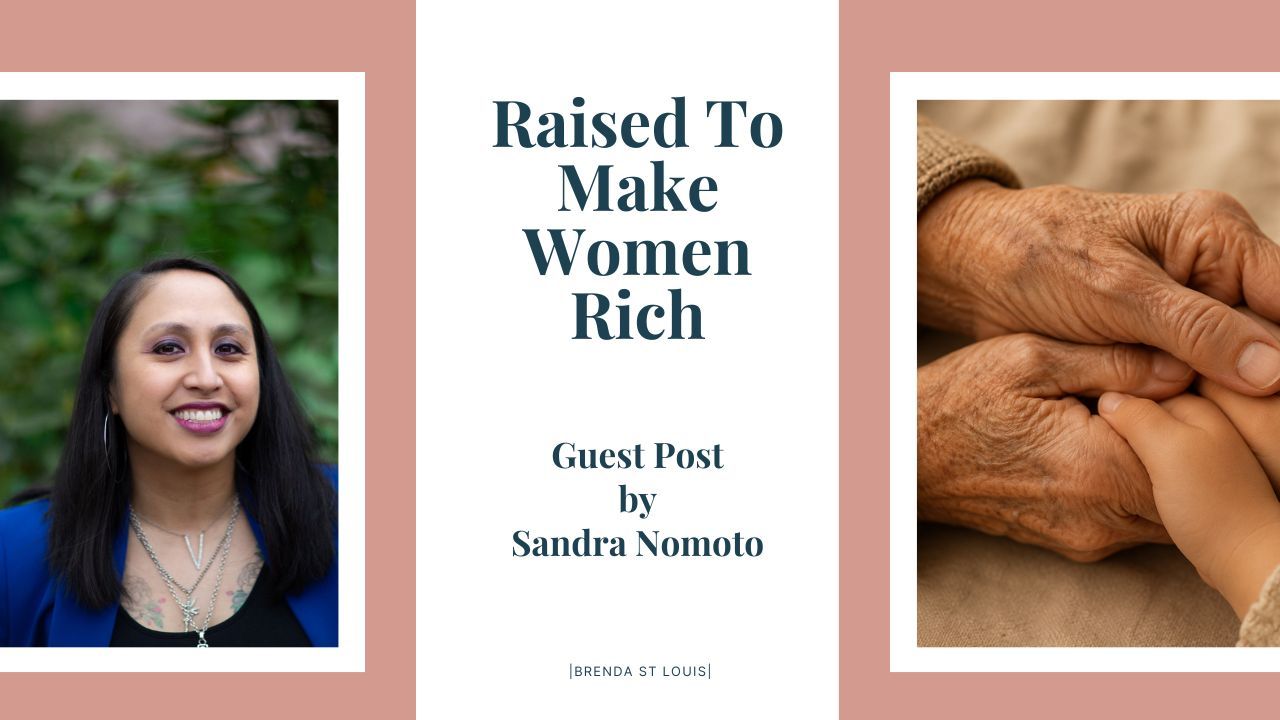
I feel honoured to share my blog space with Sandra Nomoto this week.
Sandra helps ethical women leaders become visible. But her story goes deeper than that. It's about a mother's vision, a family that went through a hard stretch, and the way money shapes what we believe we're allowed to want.
She has real insight and years of experience behind her. I think many of you will see yourselves in what she shares.
I'll let her take it from here.
Why I work to make women visible
The 3 top leadership traits I've learned from working with women
I was raised to believe my calling was to make other women rich. Let me explain.
My mother taught my siblings and me how to read around the age of three. A nurse, she often worked night shifts and took care of us during the day before we were old enough to attend school.
My sister and I had a big children's book that had illustrations of animals and words to describe their lives, while teaching children about human lives. One page was dedicated to careers. Mom wrote our names underneath the illustrations of the animal doctor and the animal dentist.
"Sandra is going to become a dentist and fix my rotten teeth," she said. "And you will both become rich and buy me a mansion."
Become rich, buy Mom a mansion. Got it!
Throughout our childhood, my parents implied that the key to becoming rich was to get a good job. The key to getting a good job was to get good grades and a college degree. That was the path they took, so I thought that was my path too.
When I was about nine, my father went to a physical rehabilitation centre for about a month. He was diagnosed with rheumatoid arthritis from a young age, and we always knew he had the condition. I understood little of what was going on then, but learned when I became an adult that he'd had a flare-up and let his pain and immobility get so bad that one day, he couldn't get up from bed to go to work.
Learning leadership from Mom
While Dad was in rehab, Mom continued to work and run the household, shuttling all three of us to school and music classes afterwards. While a part of me wishes my parents had told us what was going on, I can understand Mom's decision to maintain a sense of normalcy while things were hard.
Later, I learned we were living on a single-income household while Dad was sick. To make matters worse, when he got better, his company was acquired, and he was laid off.
My sister told me she remembered a box of food being dropped off at our front door. I don't know if that was from the government or friends of our family who were helping us out during that time, but I plan on asking Mom to find out.
After five years of learning the flute, Dad said I had to tell my flute teacher I was done, because my parents couldn't afford my lessons anymore.
"I'm not coming back after summer," I told Mrs. Martin.
"Why not?" she asked, raising one eyebrow like she always did when she was surprised.
I replied, "My parents don't have the money."
Building a career supporting women
By the time I was in college, I thought I was going to get one of those good jobs, buy a condo downtown, and be able to walk to my office.
I started as an unpaid intern at the first company that took me on full-time, a public relations firm. It wasn't downtown, but within a year and a half I was promoted to assistant to the two female partners. Years earlier, my sister had gone from administrative assistant to a partner in a small business. So when it came time to leave that company, I thought I could follow in her footsteps and become a business owner too.
I tested out my publicity chops by working with one of my besties, an artist, helping her get her first art exhibition in the media. My old boss gave me my first paid client, a woman-owned mobile spa company.
Over the course of a decade, I expanded my agency to include a small team. We worked with many women-owned companies, aiming to promote socially responsible companies in Vancouver or in North America.
I closed the company in 2018 and began freelancing as a personal or executive assistant as I figured out my next career move. One client was an actor who'd recently blown the whistle on a self-development program that ended up being a cult. Another built the first sustainable business directory. Another founded companies in the cannabis tech and psychedelics space, and still another was a previous agency client who founded a nonprofit dedicated to coworking spaces with childcare.
Each of them was doing important work in the world—and they're all mothers. While I wouldn't say being a mother automatically makes you a good leader, it forces you into becoming the leader of a household.
Even as I started a new business copywriting and working with authors in 2020, I continued to have women as clients. Here are the 3 top leadership traits I've learned from them:
Empathy: Women lead with values. They want to get shit done, but they also care. About people, the planet, and, with a lot of my vegan clients, the animals, too. I never have a problem answering texts in the evenings or on weekends if I have an empathetic client.
Delegation: The woman whose assistant I became told me at our first meeting: "A good assistant anticipates needs." I've never forgotten that. She knew that her time was better spent doing other things besides administration, and to this day I'm part of the team that helps produce her podcast.
Gratitude: Women expressing gratitude for the work her team does goes a long way. This is where men may think expressing emotions is weak, but it's not. Gratitude lets the rest of us know our boss/client sees and acknowledges our work.
Dedicating my career to amplifying female visibility
I never set out to work with just women, but I suppose Mom's vision long ago had a big impact on me.
As an adult, I've learned that women still lack pay equity compared to men, although they run 90% of the household income in most countries globally.
I don't believe in entitlement, but I believe in fairness. That's why I'm passionate about helping ethical female leaders become more visible. My experience promoting businesses and events in media for almost two decades, publishing two books and marketing other authors' books, writing for a podcast, and as fractional marketing manager for an event series all come together in my new role as a personal brand manager.
Working closely with leaders and getting to know their businesses, goals, and lives is something I'm great at. If I'm helping an ethical woman become more visible, I can feel good about what I'm earning.
I might not be getting Mom that mansion, but if she learned about the work I've done to support other women, I think she'd forgive me.
Sandra Nomoto is a personal brand manager for established ethical female leaders who've already built brand traction and are ready to scale their impact. Sign up to her monthly newsletter and her guide to personal branding.


