She Built a Magazine About Living Slowly. Then We Uncovered What Is Actually Stopping Her.
Jun 22, 2026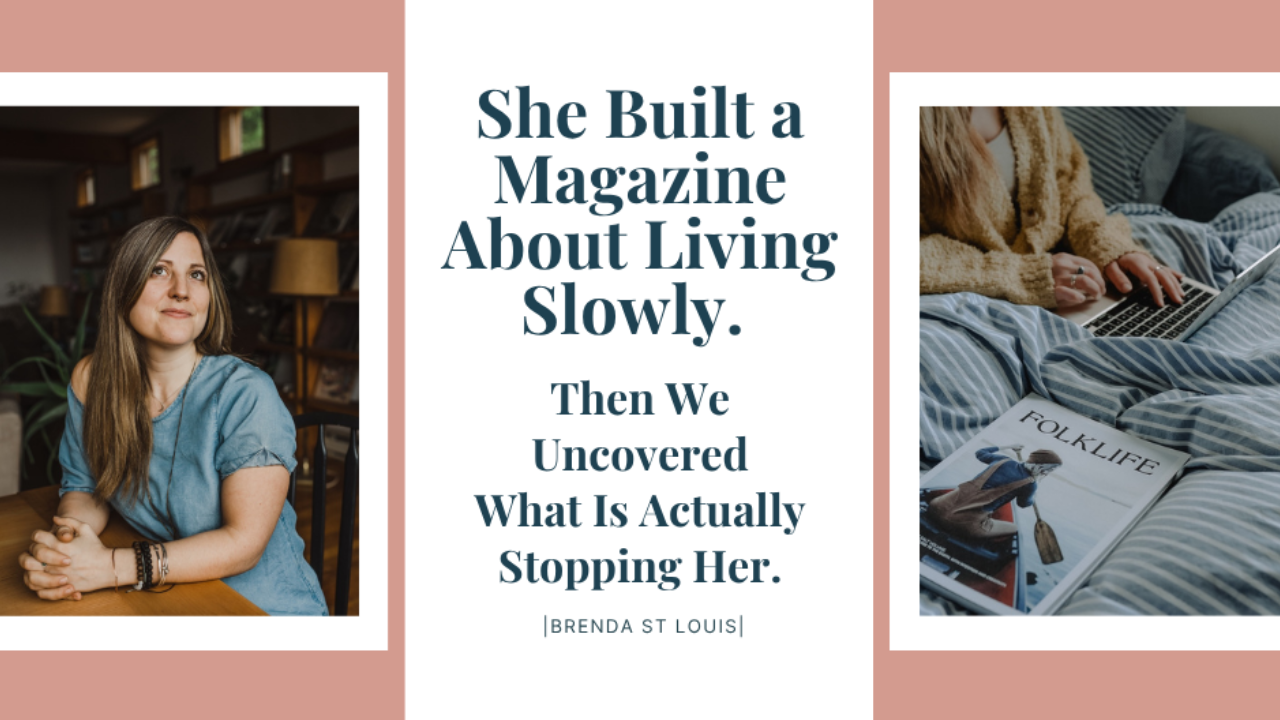
By Brenda St. Louis | Financial Therapist & Founder of Brenda St. Louis Financial Therapy
I want to tell you about a woman who built something beautiful — and then realized she'd been quietly keeping it small.
Her name is Alina Cerminara. She is the founder of FOLKLIFE Magazine [https://folklife.ca], one of the most quietly stunning publications coming out of Canada. It's a semi-annual print magazine celebrating the people who live close to the earth, move with intention, and craft life as an art form. People who chop their own wood, grow their own food, barter instead of buy, and have decided that a life of meaning matters more than a life of performance.
It's a gorgeous thing. I couldn’t help but gush about it within the first five minutes of our discovery call.
And then she told me why she reached out.
The Paradox Living Inside the Woman Who Celebrates Intentional Living
Alina came to me in January of this year with what she described as a clear goal: make money. But in the same breath, she told me something that stopped me in my tracks.
"I have guilt around having money or wanting to earn money. I think I have to get over that before I can really grow my business."
She told me she had been running FOLKLIFE with the quiet internal agreement that it's fine if it doesn't make money — it's making enough and it’s making a difference, and people love it.
And here's the part that really got me: Alina is actually great with money on a practical level. She's not an overspender. She's not carrying debt. She comfortable looking at numbers. Managing cash flow doesn't blow her nervous system.
But she had been carrying something much harder to name.
"My issue has been feeling unworthy or undeserving. And also really guilty about the fact that I already have enough to get by. So why should I want any more? Why do I deserve more?"
She paused and said something I want you to sit with: "I don't have a lot of money comparatively. So it's weird that I think I don't need it."
That sentence is one of the most honest things I've heard a client say in 20 years of this work. Because it points to something that lives so much deeper than a bank account.
It points to a belief.
Why Intentional Living Doesn't Fix Your Money Story
Here's the paradox I've watched play out over and over again in my practice.
The people who are the most intentional about how they live are often the least examined about why they feel the way they do about money.
The person who left the six-figure job to open a pottery studio. The family building an off-grid homestead on Denman Island. The independent publisher who launched an award-winning magazine in a pandemic — fuelled by love, community, and a refusal to let the hustle be the story.
These are remarkable people. And they often carry the heaviest, most unexamined money stories of anyone I've ever worked with.
Because when you build a life that doesn't fit the mainstream — one that values barter over buying, meaning over metrics, and connection over competition — the old beliefs about money don't disappear. They just find new language.
I don't need much. I'm already lucky. Who am I to want more? Does wanting financial success mean I've sold out?
That's not anti-capitalism. That's a story. Usually one that started long before she ever published her first issue, planted her first garden, or moved to an island at eighteen.
FOLKLIFE Already Asked the Money Question
I'll be honest, I was a little awed when I discovered that FOLKLIFE had dedicated an entire volume to money.
Volume 6. The Money Issue.
In it, FOLKLIFE explored money through the lens its readers understand, not as a spreadsheet, but as a value system. It asked: what does it mean to leave a high-paying job for something more aligned with your soul? To live on the economic edges of society by choice? To barter, trade, gift, and build community economies where value flows back instead of up?
The volume description reads: "The lack of it, the abundance of it, and the need to have more of it. Although the FOLKLIFE lifestyle is really about valuing something less tangible and harder to commodify."
Because it gets at the exact tension my clients live in — especially the ones who have already opted out of the conventional story. They've questioned the mainstream. They've built something different. And then the question of money shows up and suddenly all the old feelings come flooding back.
FOLKLIFE opened that door. My work, and specifically the Intergenerational Money Reset — walks you through it. [CLICK HERE]
What Ten Sessions of Financial Therapy Actually Looked Like
Alina didn't come to me with messy money. She came to me with a belief system that had made playing small feel safe.
She knew she was the bottleneck. She said it herself on our very first call: "Mega. I'm totally the bottleneck."
But she didn't yet know why.
Over our ten sessions together, we did what I call forensic money work. We went through her entire money story — every memory, every message, every moment that had shaped what she believed about deserving, wanting, and growing. We sat with the uncomfortable stuff. The guilt. The scarcity disguised as contentment. The belief that wanting more meant wanting too much.
And eventually, we found it.
The belief underneath all of it wasn't really about money at all.
It was: I don't matter.
Not in any dramatic way. In the everyday, insidious way that shapes every decision — the risks she doesn't take, the rates she won't raise, the growth she doesn't pursue, the rooms where she goes silent instead of speaking up.
Alina traced it back. A childhood spent not being the focus. A farm, youngest of five, a scary father, a busy mother who left him when she was five. An independent little girl who figured things out for herself. And a whole lifetime of quietly finding confirmation that the belief was true, because that's what unexamined beliefs do. They don't look for evidence they're wrong. They collect evidence they're right.
By our final session, she was calling bullshit on it. Out loud. In all the voices. The crying one, the cartoon one, the angry one — the full, ridiculous, human range of it. And she meant it.
What Changed
By our tenth session, something was visibly different about how Alina was thinking about FOLKLIFE.
She was moving toward creating a new direction with the magazine, which would open the door to funding in creative ways, potentially six figures annually. She had identified a managing editor she wanted to bring on: someone to run the business side so Alina could focus on the editorial heart of what she'd built.
She was building something bigger than she'd ever let herself build before.
She told me she'd been inspired by a two-person organization she'd discovered: one person makes the thing, the other person runs the business. That's what I want, she said. That's what I'm going after.
That is not the same woman who came to me in January saying it's fine if we don't make money.
That is a woman who has stopped organizing her life around a belief that was never hers to begin with.
The Intergenerational Thread
Here's what I know about the community FOLKLIFE serves.
The people living intentional lives on the Gulf Islands, in co-ops on Denman, in tiny homes on Salt Spring, on farms on Gabriola — they've made brave choices. They've questioned the narrative. They've said: my values matter more than a conventional life.
But those values didn't appear out of nowhere. They came from families. From lineages. From grandmothers who sewed through hard winters and said don't be wasteful. From parents who worked themselves to the bone and still felt like it was never enough. From communities where talking about money was either taboo or tinged with shame.
We carry those stories. All of us. And the most intentional among us often carry them most quietly — because the very language of intentional living can become a beautiful cover for never examining what's underneath.
That's what the Intergenerational Money Reset is designed to do. And if you want to understand what those patterns look like and where they come from, I wrote about that here. [ Nervous System blog]
The IMR: A Different Kind of Reset
The Intergenerational Money Reset — IMR — is not a budgeting program. It is not a "6 steps to financial freedom" promise.
It is an invitation to look at the money story that was handed to you — through your family, your culture, your childhood — and finally, with precision and gentleness, put it down.
What comes after? A relationship with money that actually belongs to you. One you chose. One that can hold both deep values and real financial wholeness — because those two things are not opposites. They never were.
The IMR opens soon. If you've been reading this and feeling a resonance — yes, this may be a sign — I'd love for you to be inside.
[Join the IMR Waitlist] https://www.brendastlouis.com/intergenerational-money-reset
What's Coming Next
Next blog I want to talk about what happens after you've built something remarkable. What happens to the money when success finally arrives — and why even the most accomplished women often don't have a financial floor underneath them.
Brené Brown earns around $10 million a year. The question I keep asking is: what happens to that money? And what does her success reveal about what every woman needs to build, regardless of income level?
Go Find FOLKLIFE
Before you do anything else today, go spend some time in Alina's world.
FOLKLIFE Magazine [https://folklife.ca]
Browse their online stories — moving essays, seasonal recipes, reflections on place and purpose. Order the volume that calls to you. Subscribe to their newsletter, which they describe as "a gentle, artful dose of slow living — no noise." Follow them on Instagram at @folklifemedia [https://www.instagram.com/folklifemedia/].
If you live on or near the Gulf Islands, you already know what I'm talking about. For everyone else — this is the magazine that made me want to book a week on Galiano Island. It's that good.
Alina built something that is, in her own words, a window seat into the slow life of Canada's West Coast.
And she is now, for the first time, fully letting herself build it.
AUTHOR BIO
Brenda St. Louis is a financial therapist and the founder of Brenda St. Louis Financial Therapy [brendastlouis.com]. She works with women to transform their relationship with money at the nervous-system level — blending financial therapy, somatic healing, and intergenerational work. Her signature programs include the Intergenerational Money Reset (IMR), Paycheck to Prosperity (P2P), and Rewire Your Wealth (RYW), with 1:1 coaching available year-round. Follow her on Instagram [https://www.instagram.com/brendastlouis/].
This blog was written with Alina's full knowledge and permission. She reviewed this piece before publication.


